
Seattle light rail vs DC, NYC, and SF
Sound Transit 3 made headlines in March by releasing its plans for the next 25 years. I have to admit, I will take all of the above when it comes to transit, but I was also taken aback. Immediately after college I lived in Washington, DC. I know what a functioning CITY light rail system looks like. It enabled you to reach most neighborhoods in the city easily, without a car. Add a bike to the mix and I easily functioned in the city without ever needing to own a car. What Sound Transit is proposing was not a CITY system (sadly). So what exactly is Sound Transit offering?
Inspired by Radical Cartography’s voyage of Manhattan and hoping to build out something (someday) like True Size Of… I did a quick GIS exercise, where I took shapefiles of New York’s Subway, D.C.’s Metro, and San Francisco’s BART and projected them at the same scale as the future Seattle system (with a little help from the a properly scaled Seattle Times infographic.) First, Here is just Seattle’s system. (you can right-click on the images and open them in a new tab to see larger versions).
Seattle

Next, I added DC
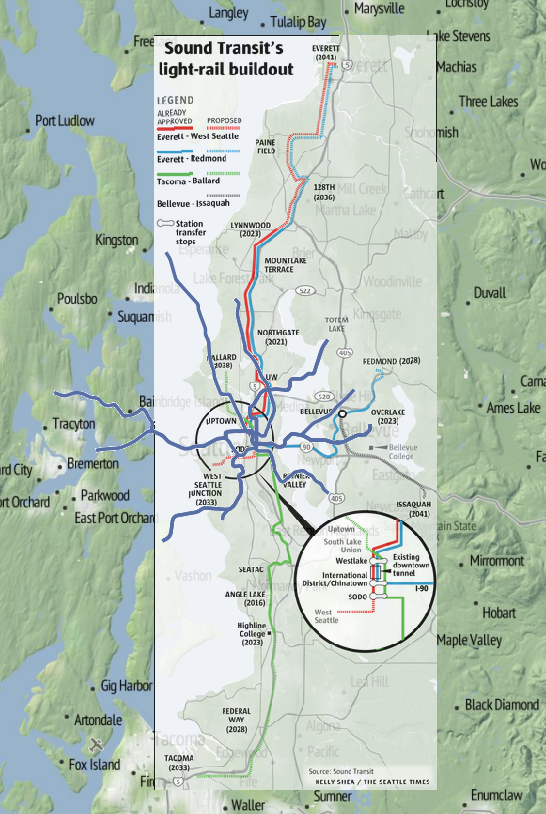
San Francisco
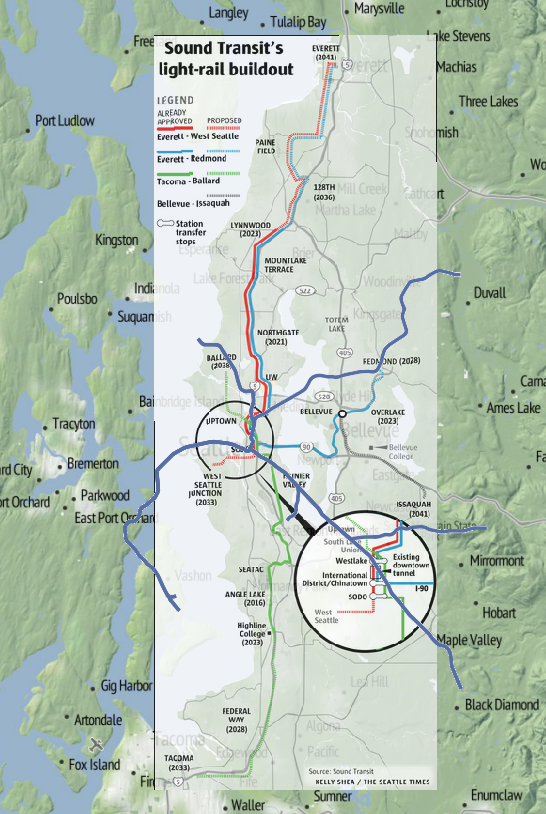
And the granddaddy of them all, New York City.
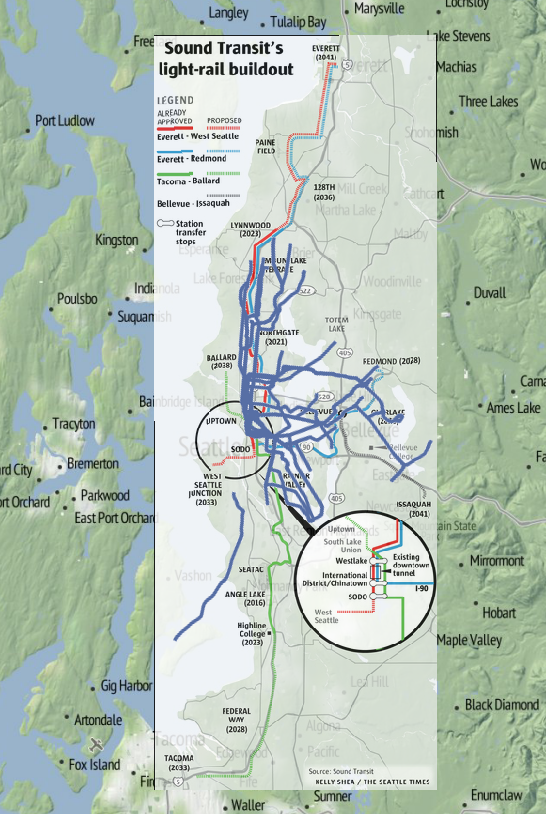
First and foremost, Seattle is huge. It dwarfs Manhattan. Second, what type of system are we getting? San Francisco’s. Its oddly fitting, as people argue that Seattle is headed that direction anyway. We get long, spindly light rail lines, with surprisingly large distance between stations, rather than the dense subway systems of DC and New York. The beauty of the DC Metro is that you usually are a reasonable walking distance away from it. That walkability made the system work. Seattle seems a far way off from ever having the same level of walkabilty. Which means that even in 2040, unless the start and finish of your trip happens to land on that thin ribbon of light rail, light rail isn’t going to be a solution for you.